G301 Non-Physical Components Of Megalithic Locations And Their Implications
Editors advise caution on OOPARTS series of articles.
This article discusses the idea that ancient megalithic locations and sites have a non-physical component; a designed energy field for one reason or the other. And it’s an interesting idea and concept.
After all, it shakes the entire foundation of the idea of “cave men” being dumb, brute savages. Which is the Newtonian, and Victorian narrative.
And instead gives us a picture of an astonishing understanding of things that are far in advance of what their physical accomplishments might say otherwise.
Is there MORE to the eye when you look at these 10,000 year old piles of rock and stone? Are there magnetic alignments, electrical currents, eddy currents and forces that geographically exist, but is not discernible to those without the necessary equipment?
And if so…
Then 10,000 years ago either
Ancient humans had the ability to naturally sense these magnetic or electromagnetic lines of force.
Or,
They had equipment that could.
They’re Alive! Megalithic Sites Are More than Just Stone
By Freddy Silva
It doesn’t take much to stimulate the human body’s electro-magnetic circuitry, in fact a small change in the local environment is enough to create a change in awareness.
People who visit ancient temples and megalithic sites often describe such a sensation. The standard explanation is that such feelings are nothing more than a ‘wow’ factor: the result of visual stimuli from the overwhelming impression generated by megalithic constructions such as stone circles, ancient temples and pyramids.
But the cumulative evidence proves otherwise: that megaliths and other ancient sacred places are actually attracting, storing, even generating their own energy field, creating the kind of environment where one can enter an altered state of consciousness.
Generating Energy Fields
In 1983 a comprehensive study was undertaken by engineer Charles Brooker to locate magnetism in sacred sites. The test subject was the Rollright stone circle in England.
A magnetometer survey of the site revealed how a band of magnetic force is attracted into the stone circle through a narrow gap of stones that act as the entrance. The band then spirals towards the center of the circle as though descending down a rabbit hole.
Two of the circle’s western stones were also found to pulsate with concentric rings of alternating current, resembling ripples in a pond.
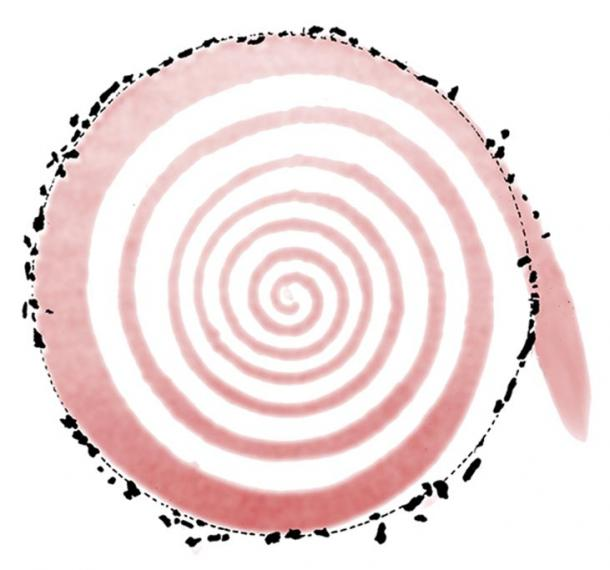
Magnetomer survey image of the Rollright Stones. Adapted from Charles Brooker. Magnetism and Standing Stones, New Scientist, January 13, 1983.
The analysis led Brooker to state how,
“the average intensity of the [geomagnetic] field within the circle was significantly lower than that measured outside, as if the stones acted as a shield.”
Such discoveries help us decipher what the ancients were up to when they built megalithic structures. At the Temple of Edfu in Egypt there is a wall featuring what amounts to a recipe for establishing a space that differs energetically from its surrounding landscape — a temple.
The instructions describe how certain creator gods first established a mound and ‘pierced a snake’ to the spot, whereupon a special force of nature impregnated the mound, which led to the construction of the physical temple.
The symbol of the serpent has always been a culturally shared metaphor of the earth’s meandering lines of force, what scientists refer to as telluric currents.
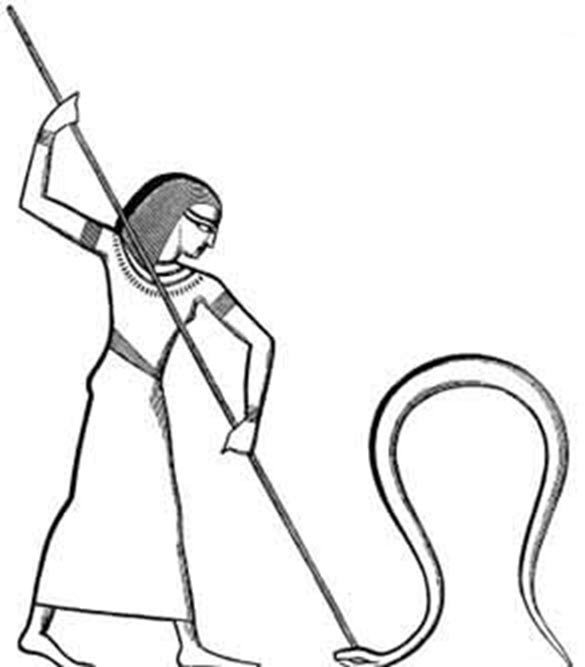
Egyptian goddess harnessing the serpent energy.
Controlling the Laws of Nature
It seems ancient architects had a fine degree of control of the laws of nature, because a recent study of energy fields in and around Avebury, the world’s largest stone circle, shows how its megaliths are designed to attract a ground current into the site.
Electrodes planted at Avebury reveal how its circular ditch breaks the transmission of telluric ground current and conducts electricity into the ditch, in effect concentrating energy and releasing it at the entrance to the site, sometimes at double the rate of the surrounding land.
Magnetic readings at Avebury die away at night to a far greater level than can be accounted for under natural circumstances.
They charge back at sunrise, with the ground telluric current from the surrounding land attracted to the henge just as magnetic fluctuations of the site reach their maximum.
Studies conducted by the late physicist John Burke also discovered how the stones of Avebury are deliberately placed and aligned so as to focus electro-magnetic currents to flow in a premeditated direction using an identical principle to modern atomic particle colliders, in which airborne ions are steered in one direction.
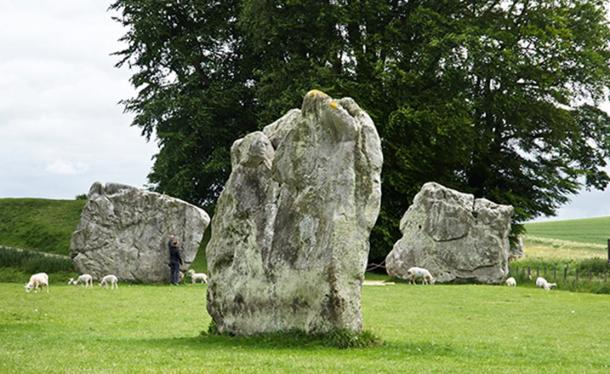
Avebury stone circle. Image by Freddy Silva.
The effect of sacred sites behaving like concentrators of electromagnetic energy is enhanced by the choice of stone. Often moved across enormous distance, the stone used in megalithic sites contains substantial amounts of magnetite.
The combination makes temples behave like weak, albeit huge, magnets.
Spiritual Technology
This has a profound influence on the human body, particularly the dissolved iron that flows in blood vessels, not to mention the millions of particles of magnetite floating inside the skull, and the pineal gland, which itself is highly sensitive to geomagnetic fields, and whose stimulation begins the production of chemicals such as pinolene and serotonin, which in turn leads to the creation of the hallucinogen DMT.
In an environment where geomagnetic field intensity is decreased, people are known to experience psychic and shamanic states.
An exhaustive investigation into the Carnac region of France, where some 80,000 megaliths are concentrated, reveals a similar spiritual technology at work. At first the leading researcher, electrical engineer Pierre Mereux, was skeptical that megalithic sites possessed any special powers.
Mereux’s study of Carnac shows how its dolmens amplify and release telluric energy throughout the day, with the strongest readings occurring at dawn. The voltage and magnetic variations are related, and follow a phenomenon known as electric induction . According to Mereux,
“The dolmen behaves as a coil or solenoid, in which currents are induced, provoked by the variations, weaker or stronger, of the surrounding magnetic field. But these phenomena are not produced with any intensity unless the dolmen is constructed with crystalline rocks rich in quartz, such as granite.”
His readings of menhirs reveal an energy that pulsates at regular intervals at the base, positively-and negatively-charged, up to thirty-six feet from these upright monoliths, some of which still show carvings of serpents.
Extreme pulsations recycle approximately every 70 minutes, showing that the menhirs charge and discharge regularly.
Mereux also noticed how the voltage of standing stones in the Grand Ménec alignment diminished the farther away they lay from the stone circle, which itself behaved as a kind of condenser or concentrator of energy.
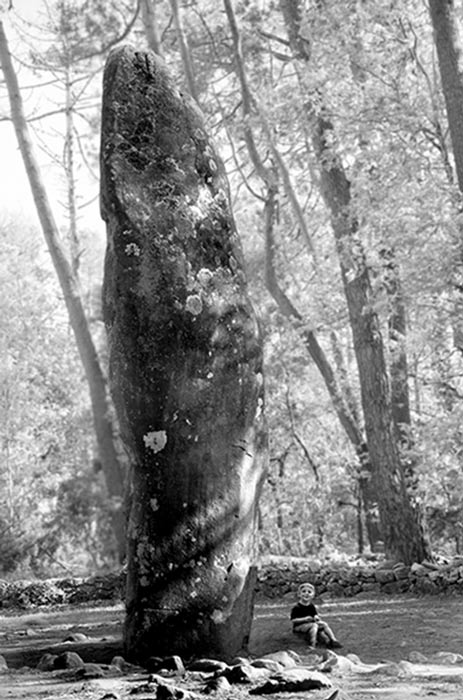
Carnac menhir caption: One of the 80,000 menhirs in the Carnac region. Image by Freddy Silva.
The composition of the stones and their ability to conduct energy was not lost on Mereux and others. Being very high in quartz, the specially chosen rocks are piezoelectric, which is to say they generate electricity when compressed or subjected to vibrations.
The megaliths of Carnac, positioned as they are upon thirty-one fractures of the most active earthquake zone in France, are in a constant state of vibration, making the stones electromagnetically active.
It demonstrates that the menhirs were not planted on this location by chance, particularly as they were transported from 60 miles (97 km) away, because their presence and orientation is in direct relationship to terrestrial magnetism.
Sacred Sites and Magnetic Portals
Ancient Mysteries traditions around the world share one peculiar aspect: they maintain how certain places on the face of the Earth possess a higher concentration of power than others.
These sites, named “spots of the fawn” by the Hopi, eventually became the foundation for many sacred sites and temple structures we see today.
What is interesting is that each culture maintains that these special places are connected with the heavens by a hollow tube or reed, and by this umbilical connection the soul is capable of engaging with the Otherworld during ritual.
However, it also allows a conduit for the spirit world to enter this physical domain.
In 2008 NASA may have unwittingly proved this observation to be true when it published details of an investigation into FTEs, or flux transfer events, in which this organization describes how the Earth is linked to the Sun by a network of magnetic portals which open every eight minutes.
Such discoveries help to validate, in the scientific eye, the long-held belief by sensitives and dowsers since the recording of history that megalithic sites and ancient temples are places set aside from the normal world, where a person can connect with locations far beyond this planetary sphere.
Certainly the ancient Egyptian priests regarded the temple as far more than a conglomerate of dead stones. Every dawn they awakened each room with orations, treating the temple as a living organism that sleeps at night and awakens at dawn.
Material based on the author's book The Divine Blueprint: Temples, power places, and the global plan to shape the human soul , Invisible Temple, 2012. Available at invisibletemple.com
Pretty interesting but wait…
…there’s more.
Maybe others have “brushed up against these discoveries” but do not realize what they have found…
Exploring the Megaliths of Magnetic Rock – Guidepost for Ancient Man?
By Charbruns
Near Copper Harbor, Michigan, USA, at the northern tip of the Keewenaw Peninsula, a large and long protrusion of rock emerges far up the hillside in deep forest.
Many petroglyphs cover this rock. It sits on the ancient shoreline of Lake Duluth. One figure is a large boat rigged with a square sail. Most viewers who trek that far into the forest proclaim it a Viking boat.
Other carvings on this stone called ‘Picture Rock’ have recently been defaced as the location becomes well known and the public gains greater access.
A dolmen, a large cap stone supported by three shim stones holding it aloft, is located on the Kelso River out of Sawbill Landing, Minnesota, within the Boundary Waters Canoe Area Wilderness (BWCA) in a national forest. Canada considers these to be lithic works created by the Neolithic cultures long before recorded history.
Many others have been found on this continent and around the world, suggesting they are guideposts for ancient man.
lithic
By definition, Lithic means “of the nature of or relating to stone.” Strong and formidable, stone has laid the foundation for infrastructure.
In ancient times, water levels were higher from melting glaciers. The surface of the earth was still pressed down from the Ice Ages and had not begun rebounding with the removal of all that ice.
If ancient boats did traverse the Laurentian Divide (a raised area across North America dividing the direction of water flow) between the watersheds, this spot is a likely possibility.
Several times I have trekked to Magnetic Rock on the border trail (prominent on the north side atop the Laurentian Divide) between Magnetic Lake and the Gunflint Trail. It was only after the Ham Lake forest fire in 2007 that the rock ‘reappeared’.
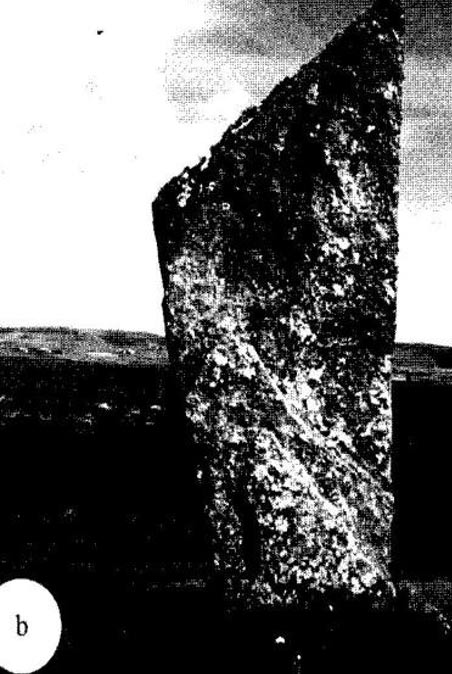
b-stone.
In an article by Wakefield and de Jong on megaliths in the Orkney Islands of Scotland, a standing menhir closely resembles the rock in Minnesota.
Dr. de Jong’s interpretation was sailing data is encrypted in the Orkney stone, explaining the unique shape and lines of the stone on our northern border.
The stone I was sitting on in photo below is possibly a shim placed to hold the stone erect. The rock was raised, by persons unknown, to mark a water passage through the Laurentian Divide. At that date, higher water levels would have created a channel.
The menhir sits on the highest elevation, according to USGS maps. The swampy valley below is the headwaters of the Cross River.
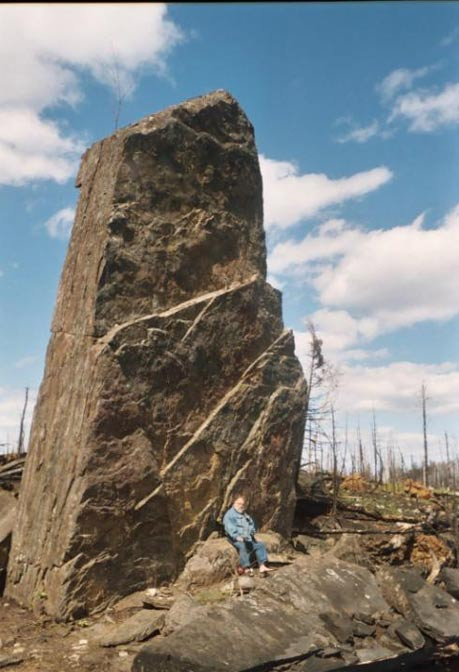
Author rests upon may have been a shim placed to hold the standing stone erect.
If this area was used by man in the distant past, supporting evidence was crucial. Further exploration produced indications of the presence of prehistoric man.
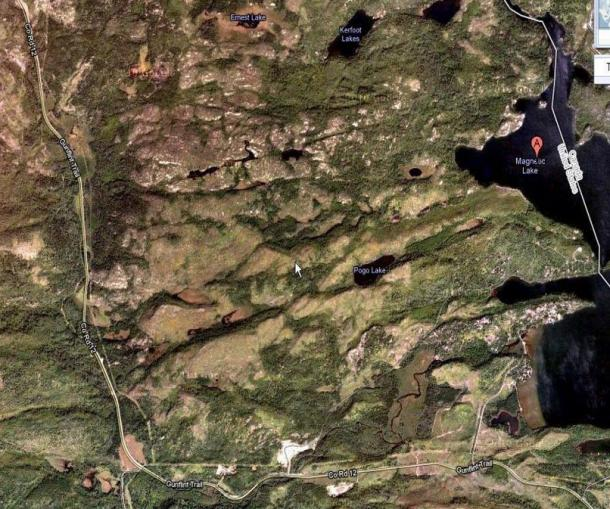
Magnetic Lake, Superior National Forest, Minnesota, and surrounds.
Magnetic Rock is the same high iron content igneous rock that makes up the Laurentian Divide. A waterhole near the Gunflint Trail attracted our attention due to the right angles and cut rocks surrounding it. Sitting next to the watercourse was a stone cube.
Two other cubes were subsequently located, the smallest on the heights east of the river.
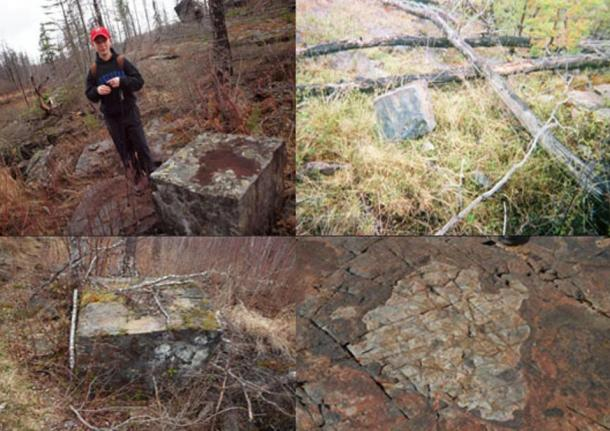
Cubed rocks.
The rock did fracture at right angles.
The lower right image might have been a demonstration of an ancient mining technique, wherein intense fire is doused with water to fracture the rock.
Today First Nation, or Native American peoples pour boiling water, during winter, into cracks in the Souix Quartzite to freeze and break apart the rocks, to aid mining of Catlinite, a reddish-brown rock in Pipestone, Minnesota.
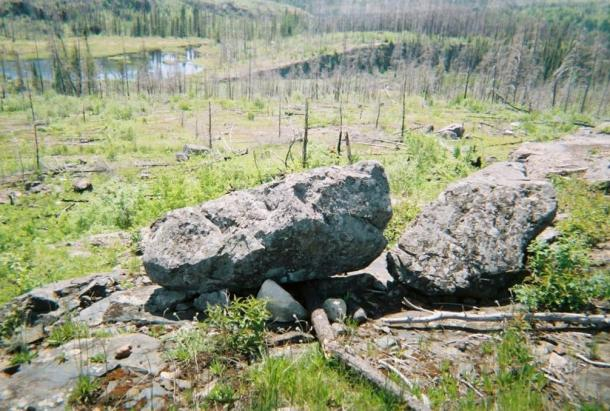
On the ridge overlooking this area, large boulders were placed exactly on the top edge of the slope and prepared with trigger stones to be rolled down the hill. They dot the cliff line, and one is shown in detail.
They are a fixed defense and would require more than one person to function. The purpose for these rocks is not known, but they are obvious in intent and lethal in scale. The border trail heads north from here along the ridge of a cliff that leads to Magnetic Rock .
On the west edge of this cliff, on a short ledge four feet below the summit, was a cache.
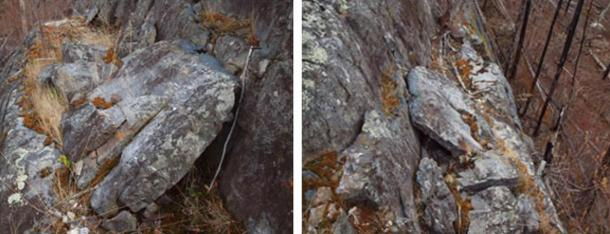
West Edge
It is well designed and skillfully made.
The right image shows where the cap stone was taken from the cliff, then moved horizontally along the ledge through human effort. While the chamber is empty today, detritus has accumulated on the ledge, awaiting qualified investigation.
Across flowing water to the east, on a ledge below steep cliffs, sits a large boulder calling attention to itself by shape and position in the landscape.
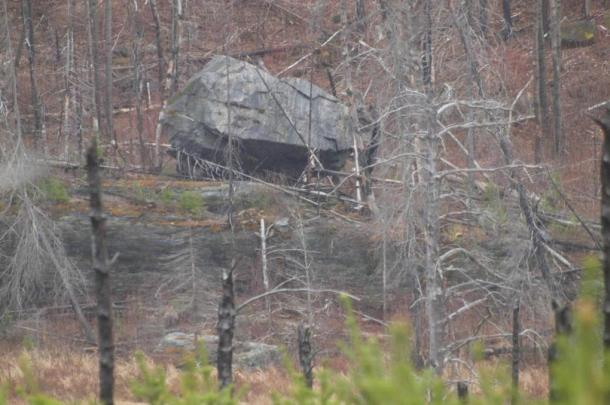
Kerri Jones of Thunder Bay, Ontario, Canada, took a telephoto image.
This rock, upon closer examination by Diane Bruns, showed chisel marks and shaping.
While not a classic dolmen, I believe this qualifies as a piece of Neolithic rock art.
The placement, shape, and expression speak too much of the monuments left by man in this time, contemporary with Stonehenge in Britain and the pyramids of Egypt.
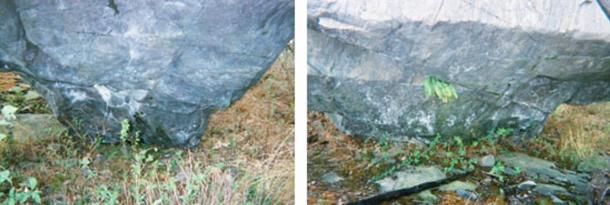
An amethyst deposit was removed directly beside the menhir and a “sun sign” remains. The rock is igneous, so this is not a fossil. Kasey Jones, pointing, said this was found close to magnetic rock.
Note the sun sign on the Kelso Dolmen, so-named for the Keslo River (below, hand calling attention to the symbol).
Since this photo was taken, the standing stone has fractured due to natural forces and a large slab has calved off the side, now covering this important piece of evidence of man’s activity. I fear to never set eyes on it in the future.
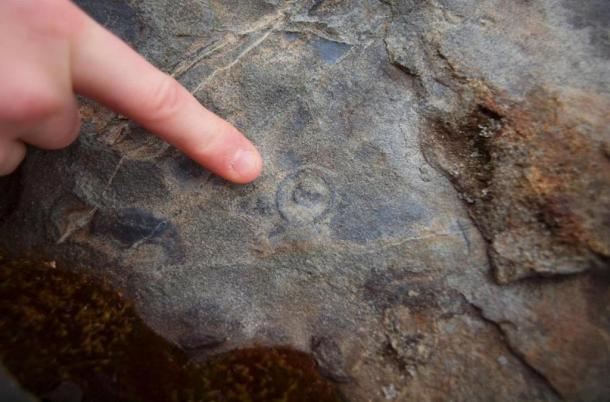
This photo by TJB Archaeological Associates-Thunder Bay, ON.
Kelso dolmen and Magnetic Rock have been shown over the internet recently on YouTube, gaining awareness.
The climb from the Gunflint Trail to Magnetic Rock was improved last year by the Minnesota Conservation Corp.
It is important to evaluate and preserve these unique sites for posterity. While the Ham Lake forest fire brought this menhir back out of the forest, the heat of the fire and exposure to elements has taken a toll.
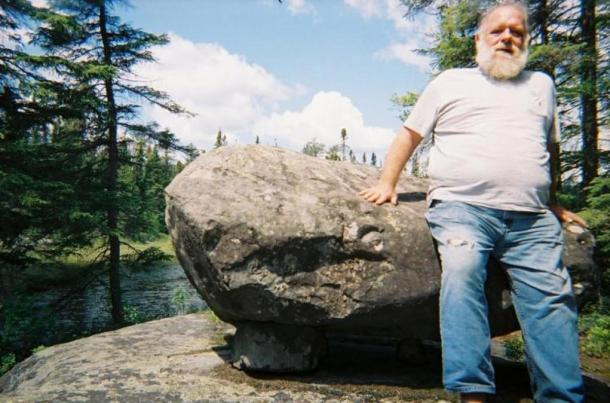
This unique spot, a transit point between watersheds, may have been used to access the rich copper deposits of Isle Royale and the Keewenaw Peninsula. Four thousand years ago higher water levels and a temperate arctic may have brought conditions allowing this.
A demand for copper clearly existed. Several locations around the prehistoric world were known for stepping up to metallurgy.
It is obvious there must have been a copper period before the Bronze Age could exist. A defining aspect of human culture is trade, and the success of many early groups was rated by the distance their resources were distributed, or the cultural practices they followed.
Float copper would have been available for easy transportation and man has always practiced war and trade, both being methods for transferring wealth.
Our technology offers new data and insights into cultures invisible to written history. Questioning and studying the aquaculture of Machu Picchu is astounding urban designers today.
It is only in the last century we understand what the stone masons were doing building the Greek Parthenon.
There are levels of sophistication we are not aware of at this time. These odd spots in the forest must be protected, and require qualified examination and evaluation with an open mind. New paradigms are arising in understanding the activities of Neolithic man.
Some Conclusions
Well, let me suggest some thoughts.
- Ancient man at 10,000 years ago had understanding and abilities regarding the ability to sense non-physical actions, and energy better than what we modern humans have.
- The mining of metals, notably copper occurred during this time with implies the utilization of metal tools.
- How the ancient peoples used their skills to both sense these fields, and fashion metals tools indicates early civilizations of a far greater capability and extraordinary utility than what has been assigned to them.
I like to believe that by studying their actual abilities at this time, we should be able to decipher more about who they were and what their societies were at that remote time in the past.